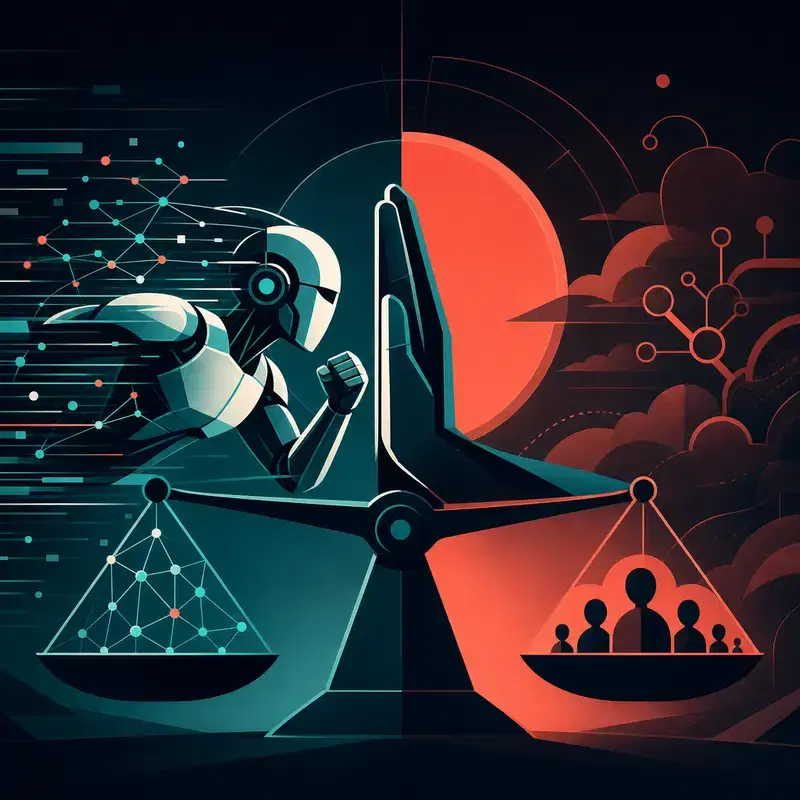
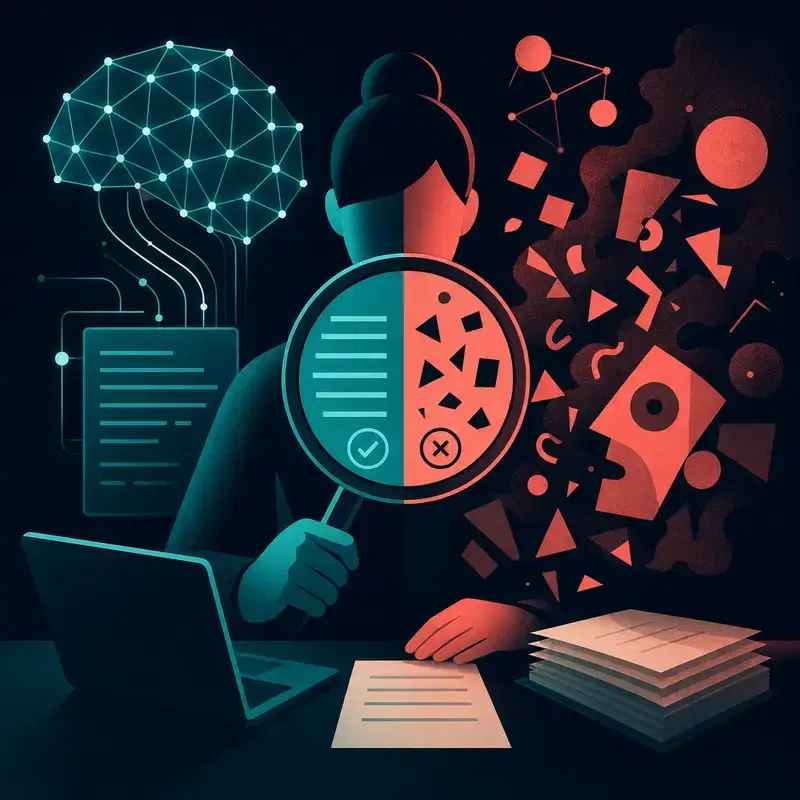
A large batch of AI-generated math manuscripts recently highlighted a key lesson for every professional using AI: generating plausible research output is not the same as verifying knowledge. Research agents are powerful because they can scale investigation, but their real value depends on provenance, review, and correction workflows.
Why this matters now
Research agents are AI systems designed to pursue open-ended questions by planning work, gathering evidence, synthesizing findings, and producing artifacts such as briefs, code, hypotheses, literature reviews, or proof sketches. They move beyond a single prompt-response interaction toward a managed workflow.
That matters because knowledge work often fails at the handoff between speed and trust. A model can draft hundreds of claims, summaries, or experiments faster than humans can review them. Without controls, this creates a flood of material that looks finished but may contain errors, duplicates, weak assumptions, or missing context.
For professional teams, the question is not whether research agents can produce more output. They can. The harder question is whether your organization can classify, verify, update, and retire that output responsibly. A useful research agent should make uncertainty visible, not hide it behind confident prose.
How it works (core definition and mechanism)
A research agent combines a language model with tools, memory, retrieval, and process rules. The user gives it a goal, such as “map competing approaches to retrieval-augmented generation” or “investigate whether this proof idea has prior art.” The agent decomposes the goal into subtasks, searches relevant sources, drafts intermediate conclusions, checks them, and records how it reached the result.
Research agent workflow
  User goal
     │
     ▼
  Plan
     │
     ▼
  Retrieve evidence
     │
     ▼
  Generate claim
     │
     ▼
  Verify
     │
     ▼
  Log provenance
Agents turn a goal into claims, checks, and traceable records.
The core mechanism is orchestration. A planner decides what to do next. A retriever brings in relevant material, often using text embeddings and vector databases to find semantically similar documents. A generator turns evidence into explanations, arguments, or drafts. A verifier checks whether claims are supported, whether sources conflict, and whether the output needs human review.
The most important design principle is separation of roles. “Generated” should be labeled differently from “verified.” A draft literature review, a machine-checked proof, a human-approved conclusion, and a withdrawn claim are different states. If your system stores them as the same kind of object, it cannot support serious research governance.
Real-world applications
In scientific and technical research, agents can scan literature, identify related work, propose experiments, translate informal reasoning into formal structures, or help maintain review queues. They are especially useful when the search space is large and the first task is triage.
In product and strategy work, research agents can compare markets, summarize customer feedback, track competitor patterns, and prepare decision memos. The benefit is not replacing judgment; it is giving experts a better starting point and a clearer audit trail.
In software engineering, agents can investigate codebases, reproduce bugs, draft patches, or compare implementation options. For example, a team exploring Android sideloading risks or Arm big.LITTLE performance tradeoffs could use an agent to gather documentation, extract assumptions, and flag areas requiring specialist validation.
In regulated domains, research agents can help assemble evidence packs, but they also raise the bar for traceability. Teams need logs, source snapshots, review status, and correction channels.
Where to go deeper
To build practical research agents, start with retrieval-augmented generation, because agents need reliable context rather than memory alone. Then study text embeddings and vector databases, which power semantic search over documents, tickets, papers, and code.
From there, learn agent orchestration patterns: planning, tool use, evaluation, human-in-the-loop review, and provenance tracking. The durable skill is not prompting an agent to sound smart. It is designing a workflow where claims can be found, checked, challenged, corrected, and trusted.