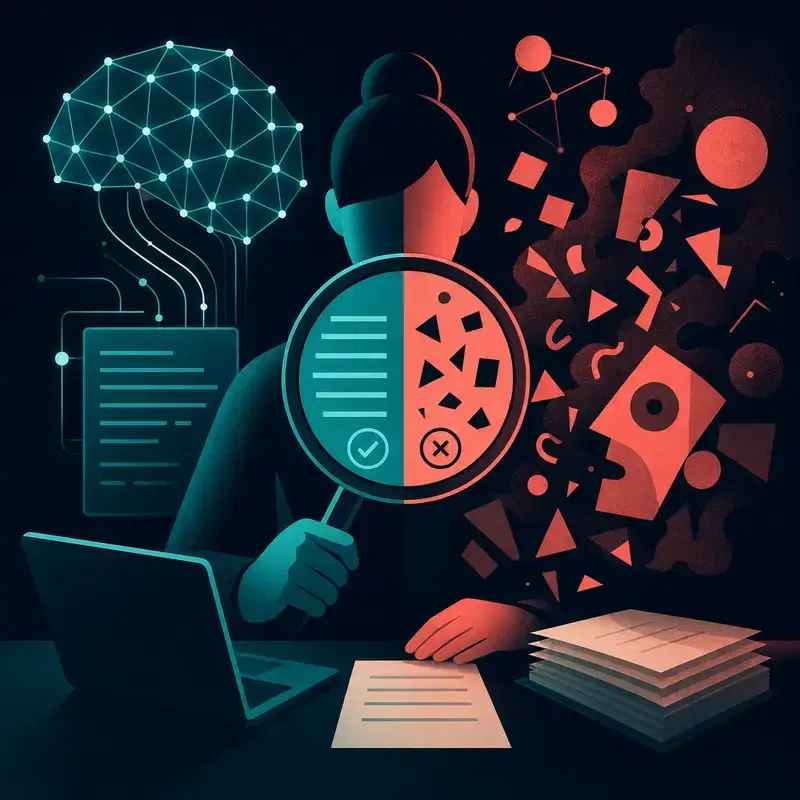
Recent agent demos show systems that can browse, code, click, and file documents on a user’s behalf. The important lesson is not that they move faster than people, but that every action needs boundaries, verification, and a clear reason to exist.
Why this matters now
Autonomous agents shift AI from answering questions to taking actions. That changes the risk profile. A chatbot can give a poor recommendation; an agent can submit a form, modify a spreadsheet, run a command, or message a customer. The same reasoning error becomes more consequential when it is connected to tools.
For professionals, the useful mental model is not “digital coworker with initiative.” It is “software system that combines language reasoning, tool access, state, and permission controls.” Speed helps only after the system knows what it is allowed to do, when to stop, and how to recover from uncertainty.
This is why restraint is central to agent design. Good agents should ask for confirmation before irreversible actions, limit their access to sensitive systems, keep auditable traces of what they did, and degrade gracefully when the task is ambiguous. In production, autonomy is less about removing humans entirely and more about deciding where human judgment belongs.
How it works
An autonomous agent is an AI system that can pursue a goal across multiple steps by observing its environment, planning actions, using tools, and updating its state. Unlike a single prompt and response, an agent runs a control loop: it repeatedly decides what to do next based on the task, available tools, prior actions, and feedback from the environment.
Autonomous agent control loop
  User goal
     │
     ▼
  Observe context
     │
     ▼
  Plan next action
     │
     ▼
  Check policy
     │
     ▼
  Call tool or act
     │
     ▼
  Update memory
     │
     ▼
  Report result
Agent work alternates between reasoning tool use guardrails and memory
The core components are straightforward. The model interprets the goal and chooses actions. Tools connect the model to external capabilities such as search, code execution, databases, calendars, browsers, or business applications. Memory stores relevant context, either short term within the task or longer term across tasks. Policies define what the agent may do, what requires approval, and what is forbidden.
The hard part is reliability over long horizons. Each step introduces a chance of misunderstanding, tool failure, bad retrieved context, or malicious instruction. A web page, document, or email can contain text that tries to redirect the agent away from the user’s intent. That is why serious agent systems need sandboxing, least privilege access, logging, confirmation gates, and evaluation on full workflows rather than isolated answers.
Real-world applications
In software teams, agents can triage bugs, inspect logs, draft pull requests, run tests, or summarize code changes. The best use cases are bounded: clear repository access, clear test criteria, and limited deployment authority.
In operations, agents can reconcile spreadsheets, prepare reports, monitor queues, or route exceptions. Here, value comes from connecting reasoning to structured systems while keeping approvals around payments, account changes, and customer-impacting actions.
In knowledge work, agents can gather sources, build briefs, compare policies, and produce first drafts. Retrieval-augmented generation is often essential because the agent needs current internal knowledge rather than only general model knowledge.
In personal productivity, agents can schedule, organize files, and fill forms. These tasks look simple, but they involve sensitive permissions, identity, and irreversible clicks. A well-designed agent should feel less like an unrestrained assistant and more like a careful operator with a checklist.
Where to go deeper
To build durable agent intuition, study retrieval-augmented generation, vector databases, and text embeddings. These explain how agents find and use external knowledge instead of relying only on model memory.
For systems thinking, Android sideloading is a useful security analogy: convenience increases when software can act outside default channels, but so does the need for permission models and trust boundaries. Arm big.LITTLE is a useful performance analogy: efficient systems route work to the right capability instead of treating every task as needing maximum power.
The transferable skill is designing autonomy with constraints. Strong agents are not merely faster models. They are controlled systems that reason, act, verify, and know when not to proceed.