Recent coverage of AI companies expanding sponsored creator posts points to a broader shift: technical products are increasingly marketed through everyday workflows, not feature lists. For professionals, creator marketing matters because it shapes how users discover, trust, and operationalize new tools.
Why this matters now
AI products are unusually broad. The same assistant, agent, or automation tool might help a product manager draft a requirements document, a founder respond to customers, an analyst summarize research, or a developer debug code. That breadth is powerful, but it creates a positioning problem: if a tool can do almost anything, many users struggle to see what they should do first.
Creator marketing solves part of that adoption gap. Instead of saying a model has a large context window or strong reasoning, a creator shows a concrete habit: clean up an inbox, prepare for a meeting, compare vendors, rewrite a proposal, or turn messy notes into a plan. The value is not just awareness. It is category education. Creators translate abstract capability into a recognizable job to be done.
This is especially important for AI because trust is contextual. A professional may not care that a tool is impressive in general. They care whether it helps in their role, with their constraints, without creating more risk or rework. A credible niche creator can make that judgment feel practical rather than promotional.
How it works
Creator marketing is a distribution strategy where trusted individuals demonstrate a product inside a specific audience context. For AI tools, the mechanism usually starts with an audience pain, moves through a creator demonstration, frames a repeatable use case, encourages a trial habit, and generates a feedback loop through comments, shares, and follow up content.
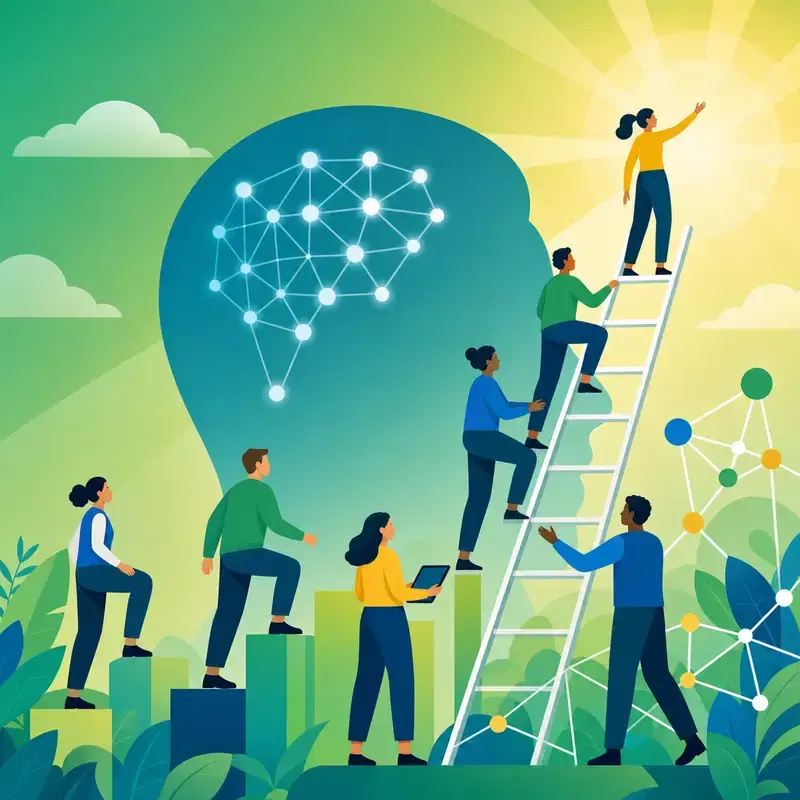
Creators turn abstract capability into a repeatable use case.
The key is specificity. A generic post saying an AI tool boosts productivity is weak. A strong creator demonstration shows the starting problem, the prompt or workflow, the output, the edits required, and the final business result. That makes the audience believe not only that the product works, but that they could use it tomorrow.
Good creator marketing also separates inspiration from instruction. Inspiration creates interest. Instruction reduces friction. In AI, both are needed because many users abandon tools after shallow experiments. The creator’s role is to make the first useful workflow obvious.
Real-world applications
For product teams, creator marketing can validate use cases before building expensive onboarding. If creators repeatedly explain the same workflow, that workflow may deserve templates, in product guidance, or dedicated features.
For go to market teams, creators can segment messages by profession. A legal operations audience needs different examples than a sales operations audience. The underlying model may be the same, but the trusted proof changes by context.
For enterprise buyers, creator activity can reveal bottom up demand. If employees are already learning workflows from practitioners they trust, adoption planning should include enablement, governance, and data boundaries rather than only procurement.
For individual professionals, creator marketing is useful but should be evaluated critically. Ask: Is the workflow transferable? Are the inputs realistic? Does the creator show limitations? Is the outcome better than the existing process, or just more polished on camera?
Where to go deeper
To understand the technical side behind AI workflow demos, explore retrieval augmented generation, vector databases, and text embeddings. These explain how systems find relevant context, represent meaning, and produce grounded responses.
To broaden your technology fluency, Android sideloading is a useful lens on distribution and platform control, while Arm big.LITTLE helps explain how modern devices balance performance and efficiency. Together, these topics build the judgment needed to evaluate not just AI marketing claims, but the systems and tradeoffs behind them.