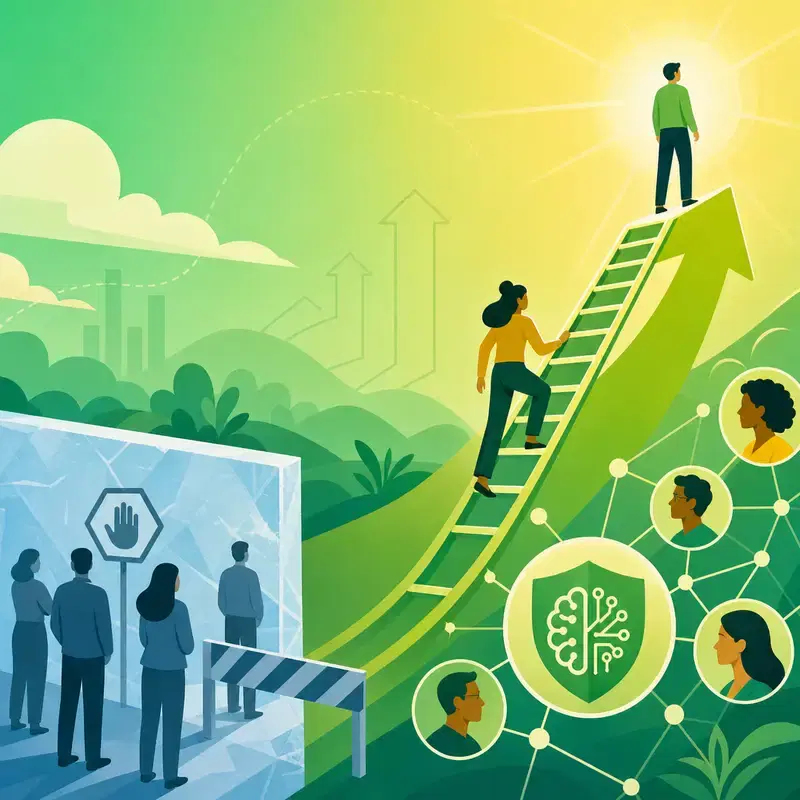
A recent enterprise software report put a spotlight on a familiar pain point: much of modern work happens in the gaps between systems. Agentic AI matters because it promises not just to answer questions, but to coordinate actions across tools, approvals, data sources, and exceptions.
Why this matters now
Traditional software is excellent inside its own boundaries: a CRM tracks customers, an ERP manages resources, a ticketing system handles support, and a data warehouse stores analytics. The friction appears when work crosses those boundaries. A person checks one system, interprets what changed, updates another, asks for approval, and repeats the pattern when something fails.
Agentic AI is relevant because it targets that coordination layer. Instead of treating AI as a chatbot bolted onto a screen, it treats AI as a goal-driven operator that can plan, use tools, monitor outcomes, and adapt when the workflow is not perfectly linear.
That does not mean fully autonomous software running unchecked. In professional settings, the useful version is usually bounded autonomy: the agent can act within defined permissions, escalate uncertain cases, keep an audit trail, and hand control back to people when risk is high.
How it works
Agentic AI is an AI system designed to pursue a goal through a sequence of decisions and actions. A basic language model responds to a prompt. An agentic system adds planning, tool use, state tracking, feedback loops, and guardrails so it can move work forward across multiple steps.
Agentic AI work loop
  Goal ·································
     │
     ▼
  Plan ·································
     │
     ▼
  Use tools ····························
     │
     ▼
  Observe result ·······················
     │
     ▼
  Decide next action ···················
     │
     ▼
  Complete task ························
An agent plans, acts through tools, checks results, and continues until the task is complete.
The mechanism is simple in concept but demanding in implementation. First, the agent receives a goal, such as resolving an invoice mismatch or preparing a customer renewal summary. It breaks the goal into steps. It then calls tools: databases, internal APIs, document stores, workflow systems, email, or ticketing platforms. After each action, it observes the result and decides whether to continue, retry, ask for clarification, or escalate.
The quality of an agent depends less on theatrical conversation and more on reliable context, permissions, and evaluation. Retrieval-augmented generation can ground the agent in approved documents. Text embeddings and vector databases can help it find relevant policies, past cases, or product notes. Guardrails define what it may do, while logs and human review make its behavior inspectable.
Real-world applications
A sales operations agent might assemble renewal risks by pulling usage, support tickets, contract terms, and account notes into one summary, then draft follow-up actions for approval.
A finance agent might compare purchase orders, invoices, and payment records, flag mismatches, request missing information, and route exceptions to the right owner.
An IT operations agent might triage access requests, check policy, verify manager approval, provision low-risk permissions, and escalate unusual cases.
A customer support agent might search documentation, inspect account history, propose a resolution, update the ticket, and trigger a refund workflow only when policy conditions are met.
In each case, the agent is valuable because it reduces cross-system labor. The goal is not to replace every application. It is to make the existing application stack behave more like a coordinated workflow.
Where to go deeper
To build durable skill, focus on the components beneath the buzzword. Retrieval-augmented generation explains how agents use trusted knowledge instead of relying only on model memory. Vector databases and text embeddings explain how systems search by meaning, which is central to finding relevant context. Arm big.LITTLE is useful for understanding performance and efficiency tradeoffs when AI workloads move closer to devices. Android sideloading offers a practical lens on deployment, permissions, and trust outside default app-store paths.
The key professional question is not “Can an agent do everything?” It is “Where can bounded autonomy remove recurring coordination work safely, measurably, and economically?”