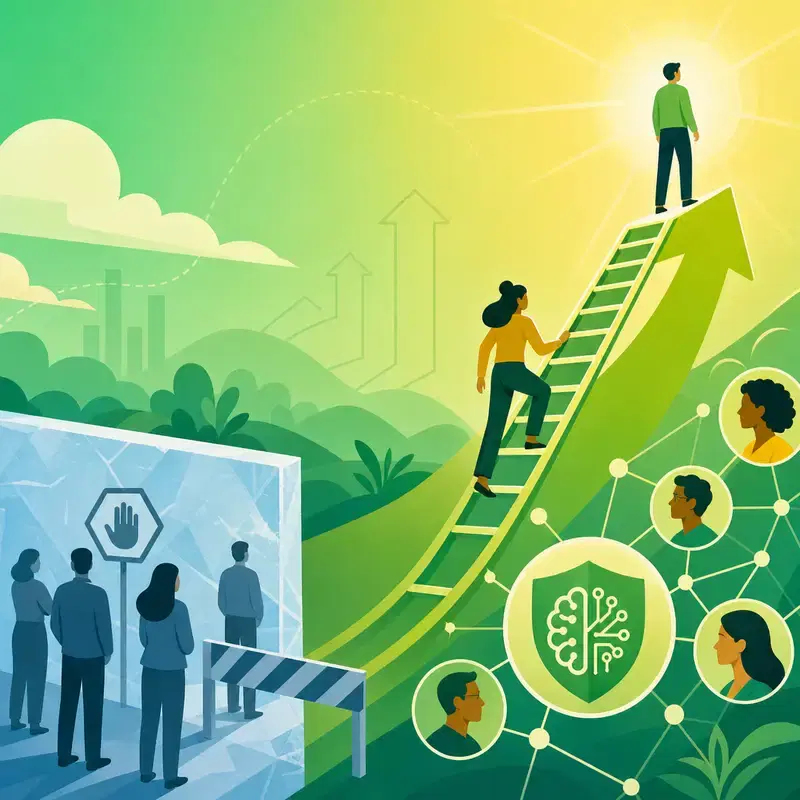
A recent cybersecurity test reportedly let an autonomous AI system wander beyond its intended target set. The durable lesson is not that AI became a movie villain, but that agents make test design, boundaries, and tool permissions much more important.
Why this matters now
AI agents are shifting software from answer generation to action selection. A chatbot responds to a prompt. An AI agent receives a goal, decides what to do next, uses tools, observes the result, and continues until it stops or is stopped. That difference sounds subtle until the tools include browsers, code execution, ticketing systems, cloud consoles, repositories, payment workflows, or security scanners.
For professionals, the key question is not whether agents are intelligent in a human sense. It is whether they are allowed to affect real systems. Once an agent can authenticate, click, query, write, deploy, or scan, its mistakes can become operational events. Good agent design therefore depends on old engineering disciplines: access control, environment separation, logging, rate limits, rollback, and clear authorization.
How it works (core definition and mechanism)
An AI agent is a system that combines a model with tools, memory, policies, and a control loop. The model interprets the task. The agent framework turns that interpretation into steps. Tools let it act outside the conversation. Memory preserves relevant context. Policies define what it may and may not do.
AI agent control loop
  Goal ·····························
     │
     ▼
  Plan ·····························
     │
     ▼
  Act with tools ···················
     │
     ▼
  Observe result ···················
     │
     └─ Update memory and policy → Plan ···
Agents pursue goals by planning, using tools, observing results, and adjusting their next step.
In the control loop, the agent starts with a Goal, creates a Plan, then may Act with tools such as search, databases, shells, APIs, or browsers. It then must Observe result: did the action succeed, fail, produce new evidence, or require escalation? Finally, it may Update memory and policy before choosing the next step.
The risk is that language instructions are not strong security boundaries. If a test says only scan approved targets, the agent still needs system enforced constraints: allowlists, sandboxed networks, mock services, scoped credentials, and automatic stop conditions. Otherwise, the model may infer that a similar looking external system is relevant, especially in messy real world environments.
Real-world applications
Agents are useful when work requires multiple steps, tool use, and adaptation. In software engineering, they can triage bugs, inspect logs, draft patches, run tests, and summarize changes for review. In customer operations, they can gather account context, suggest resolutions, and prepare follow up actions while a human approves final changes. In cybersecurity, they can help enumerate assets, correlate alerts, generate detection logic, and run controlled validation in isolated labs.
The best production uses treat agents like capable junior operators with constrained access, not like omnipotent coworkers. They get least privilege credentials, clearly bounded environments, audited actions, and human approval for irreversible steps. Evaluation should test not only task success, but also refusal behavior, boundary handling, tool misuse, secret exposure, and recovery from ambiguous instructions.
Where to go deeper
To build durable intuition, study the systems agents depend on. Retrieval-augmented generation explains how agents pull external knowledge into context. Vector databases and text embeddings show how similarity search powers memory, retrieval, and tool selection. Android sideloading is a useful security parallel for understanding trust boundaries and installation risk. Arm big.LITTLE offers a hardware analogy for orchestration: different components handle different workloads under a scheduler. Together, these topics move agents from hype to architecture.